Earth vs space
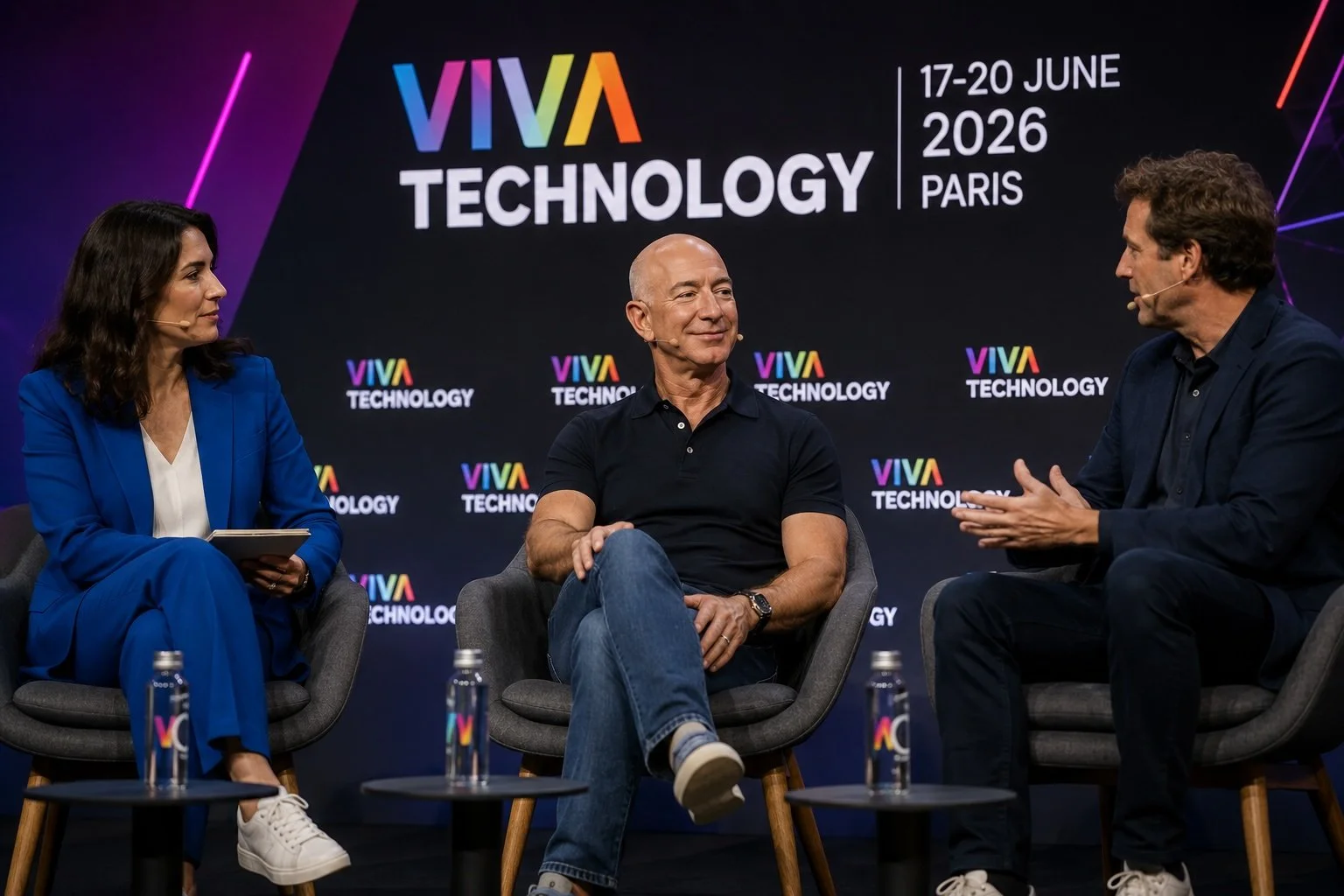
Before he even became president, Emmanuel Macron already succeeded in creating something long-lasting: VivaTech, France’s supposed answer to CES. While it isn’t quite that, the event has indeed become — in only a decade — a bona fide must-go for tech entrepreneurs, with every year bringing a new special guest based on what’s in the news. Musk was invited; this year, it was Jeff Bezos.
Interestingly, he wasn’t really there to talk about what made him rich — Amazon and AWS, but rather what is currently draining his resources (as opposed to our planet’s): Blue Origin. His space exploration venture, while significantly more discreet than his buddy’s SpaceX, is nevertheless progressing towards full-on space exploration as well. And, while Bezos had already mentioned most of what he said at VivaTech last week, it still bears repeating.
One of the crucial claims in his talk was his belief that we should effectively treat space as a dumping ground for our most polluting endeavors — in order to save Earth. What he suggests we do is relocate our most toxic industrial operations elsewhere (to the Moon first) so as to ensure that the resulting pollution doesn’t affect the Earth to humanity’s detriment. Any more than it already has, that is.
While such a statement can sound reasonable at face value, it also implies a remarkably biased point of view: one that simply considers human life to be unsustainable on Earth. Indeed, if one considers that the only way forward for our species is to merely move our most harmful industries, it means that we simply can’t do without them. And that, in and of itself, poses an immense question: is there no sustainable future for us?
In other words, will we forever be unable to regain control of our environmental footprint? Are we bound to keep moving forward, along with a problem that will no doubt only worsen? Are we to trash the Moon and/or Mars in our attempt to save the Earth? Will we even succeed? Or will we simply destroy even more than just our home planet? And by “destroy”, I mean render uninhabitable for our kind, as the great George Carlin once reminded us that the planet is fine — it is we who are f*cked?
In short — no. The idea that there simply is no way to solve our environmental issues is not only wrong, it is dangerous. It essentially serves as a great excuse for those who do not wish to change, because change requires effort, even if the end result is indisputably desirable. Because there are solutions to alleviate our current environmental concerns, at least beginnings of some: renewable energy or carbon capture are scientific routes to explore; owning less private cars in sprawling suburbs and eating less red meat, while requiring adjustments, will also make our lives better — and longer.
Then, you have the moonshot ideas — nuclear fusion arguably being the biggest. While we don’t know when it will become reality, or if it truly will, or soon enough, it would constitute a radical solution to our energy problems. Not one that would prevent us from having to clean up the consequences of our past fossil fuel usage, but still. And that is just one example we do know about: chances are we will find other promising opportunities. Perhaps using materials found on the Moon, perhaps in Maine.
While we shouldn’t rely on hypothetical get-out-of-jail-free cards either, the point here is that we should consider solutions instead of giving up without having even tried. The idea of moving the problem elsewhere without first trying to tackle it is short-sightedness at its finest: what usually happens down the line is far worse than the initially perceived threat. And, while Europe currently faces a historic heatwave and India experiences near-50°C temperatures (that would be 120°F for Mr Bezos), it is even more insulting.